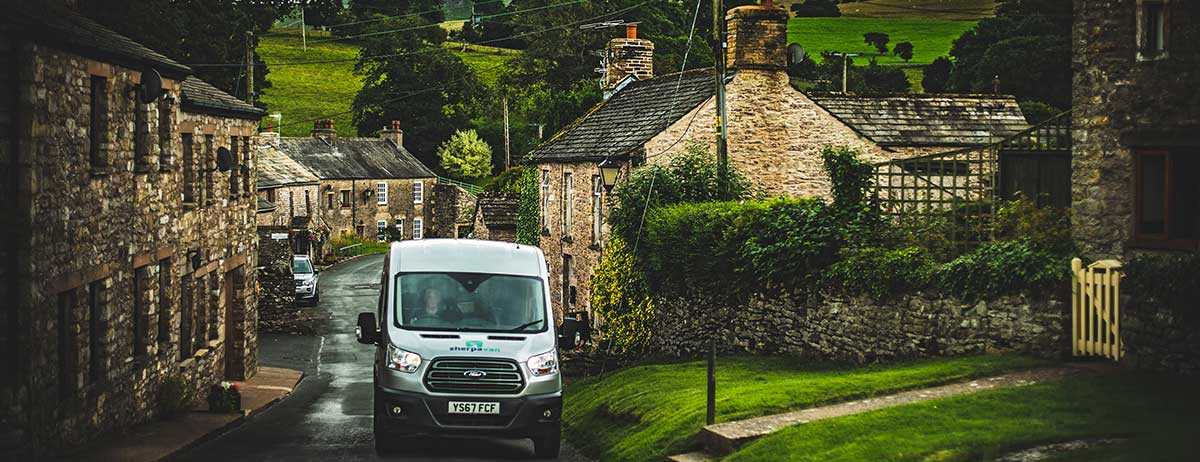
Let us do all the hard work - just choose where you want to stay. We'll make all the reservations, pick up your bags every morning and drop them at your destination the same afternoon
Arrange all the accommodation yourself - just tell us where you'll be staying each night. We'll collect your bags every day and they'll be waiting for you when you arrive at your next stop
To assist you in the planning of your walk and to accompany you along the way, we have selected the best maps and guidebooks you can comfortably carry in a rucksack pocket or walking jacket.
Each trail planner contains details of travel, overnight stops, points of interest, suggested routes, relative distances and the services we can provide. Trail planners cost £5, but for each planner you download, we will take £5 off the cost of your booking on that trail
|
The South Downs Way, stretching 100 miles over a rare large area of Outstanding natural
Beauty in crowded Southern Britain, generally follows the chalk (soft
limestone) ridge just to the north of the popular seaside towns on the Sussex
and Hampshire coast. At intervals the chalk down is broken by "Wind gaps" - river valleys, breaking the
ridge walking with some meandering visits to beautiful rivers such at the
Cuckmere, Arun. Ouse and Meon with all
their associated villages. Most of the route is ancient, made up out of the old
droving roads that took animals and goods between the market towns of the
region. There are many historical features, including a few remaining round
towered Saxon churches, ancient "Dew Ponds" providing water on the high Downs for
cattle, Cross dykes and tumulus burial sites, Bronze Age Hill forts and rings. There is not a lot of accommodation actually on the trail, and so you should bear in mind that as well as the distance of each day stage, you may have to walk an extra mile or two to your accommodation and hence back again to the route on the following morning. Some accommodations maybe prepared (perhaps at extra cost) to pick you up and return you in the morning, for instance if you were staying at Lewes, you may come off the Way onto the busy A27 for 2.5 miles, and a pick up would be most welcome. Way marking is generally excellent with the white acorn mark on posts and stiles at intervals. Please bear in mind that the trail can be very warm in summer, and there are long sections where it will be difficult finding water, so carry capacity two litres. Also except for in wet and muddy conditions, and especially in Summer, the trail is generally free draining and firm, so spare a thought for your feet and bring lightweight, well-cushioned boots, if you are used to walking in them. Rain and strong cold winds however can be expected at any time of year, so make sure you bring a rain shell and fleece. Typical ItineraryStage 1: Eastbourne to Alfriston 11 miles Stage 2: Alfriston to the A27 (for Lewes) 14 miles From the beauty of the Cuckmere River at Alfriston, The Way rises up onto the High Downs reaching a high point on this section at Firle Beacon. There are not really any services on the route until you reach the River Ouse gap near Rodmell. This is unless you elect to drop off the Downs and visit places such as Alciston, Berwick and West Firle with various pubs and teashops. Fans of the Bloomsbury group of Bohemian artists will be keen to make this diversion. After the Ouse the trail climbs around Kingston and then drops again to the A27, from where it is 2.5 miles to the historic town of Lewes. Stage 3: A27 ( Lewes) to Devil’s Dyke / Fulking 12 miles This section takes you up onto the highest parts of the Downs, round the back of the Brighton Worthing conurbation, following mainly grassy tracks. You go over the highest point on the route at Ditchling Beacon regular (weekend buses from here down to Brighton during the summer). There are not many places to eat or drink at enroute, but there is a very welcome pub at the Devil’s Dyke, serving food throughout the year and you may find an ice cream van here as well as at the Beacon. The white "Jack and Jill" Clayton windmills are also an attractive feature of the walk. Stage 4: Devil’s Dyke / Fulking to Storrington 14 miles The route descends via Upper Beeding and the Youth Hostal at Tottington Barn To the Ardur River Valley from where Shoreham by Sea can be reached to the South. There follows a lovely stretch of The Downs with great views down to the villages below and ancient historical features abound such as Tumuli burial mounds, cross dykes and the fascinating Chanctonbury Ring – a Bronze Age hill fort settlement with one or two ghost stories attached to it. The Way drops steeply to cross the A24 and then climbs once again for the leg above the town of Storrington, where beautiful downland trails or a minor road can be used to descend to the services of this town. Stage 5: Storrington to Cocking 12 miles From above Storrington the trail etches over the fields and through pockets of forest to reach and descend to the attractive Triptych of villages: Amberley, Houghton and Bury on the lazily meandering River Arun. There are great opportunities for a bar crawl between the villages, excellent ale and accommodation. The Way next follows flinty trails up Bury Hill, from where there is a footpath off The Downs to the Roman Villa remains at Bignor, and continues over Bignor Hill and its viewpoint (225m). There are many interesting historical features today including a couple of minutes on the Roman Road called Stane Street that connected Chichester with London. You could practice your navigation trying to find the Neolithic Camp justfont-family:Arial;font-style: off of the route. Chichester Cathedral is also visible seaward. Descending into the Dry valley of the A285, there is then a steep climb up to a point from where it is about 0.25 miles South (off route); to the highest point on the South Downs at Crown Tegleaze at 253 m. The route undulates across the scarp slope the Downs, soon entering dark and sometimes muddy woodland before dropping down to the A286 on Cocking Hill, from where it is a mile into Cocking village itself. Stage 6: Cocking to Buriton 11 miles Quite a convoluted and tiring section especially in bad weather when some of the woodland trails maybe very muddy and slippery. No real chance of enroute refreshment unless you drop off the way, but there is pubs at Elsted and Harting a bit to the North. There are some interesting features, including the Devil’s Jumps Tumuli; a group of large ancient burial hillocks. There is also Beacon Hill, an Iron Age Hill fort that you can pass over on the trail, which still has vestiges of the old ramparts and views towards Chichester Harbour. Stage 7: Buriton to Exton 12.5miles Until 1989, Buriton was the end of the route, but now it has been extended another 25 miles. From above Buriton, The Way climbs and then descends through the Queen Elizabeth Country park. There is a café and public Toilets. You then pass under the A3, and climb steeply up Butser Hill with Bronze Age field patterns etched upon it. The route then undulates over The Downs into some vast arable countryside. Then it is a steep 100-meter climb up to "Ol’ Winchester Hill," a National Nature Reserve from where the isle of Wight can be seen on a clear day. Descend to Exton (if walking) beside a beautiful clear chalk stream in which you may see Brown Trout gliding about. At the end of the section, The necklace of Meon Valley villages: Exton, Corhampton and Meonstoke are all within a mile of each other and are beautiful places to stay around and to quaff beer by as the Meon River is a real gem! Stage 8: Exton to Winchester 12 miles This last section, perhaps the least interesting scenically and historically, stretches from the Meon valley up Beacon Hill with its rare Spring and summer plant life. The Hampshire Downs then open up and roll on as you pass field after field. Hopefully you will have some variety by reaching the "Milburys" pub when it is open around lunchtime. Via the old Manorial parish of Chilcomb and crossing over the busy A272, you arrive at ye old Saxon capital of fayre England: Winchester. Home of Alfred The Great, the Roundtable (a mediaeval creation), and the Cathedral with the longest Knave, but one of the shortest towers in Britain. Arriving by Train: The start of the South Downs Way is on the outskirts of Eastbourne in East Sussex, reached by trains from London Victoria (approx 2 per hour, less Sundays) Journey time 1.25 hours. Up to the minute information regarding departure times, journey times and details of prices, is available from British Rail information on 08457 484950 (24 hour service, local rate call within UK), or visit www.railtrack.co.uk. Departing by train at the end of the tour: The South Downs Way ends at Winchester in Hampshire. From here there are trains to London Waterloo. There are as many as 4 services an hour taking just over an hour. Services are direct. Most convenient international airport: Gatwick. From the airport there are hourly direct trains to Eastbourne taking 51 mins. From Winchester to Gatwick at the end there are several possible trains leaving each hour, changing variously at Woking, Basingstoke, Cosham and Clapham Junction. Journey times around 2 hours.
Arriving by car:
|